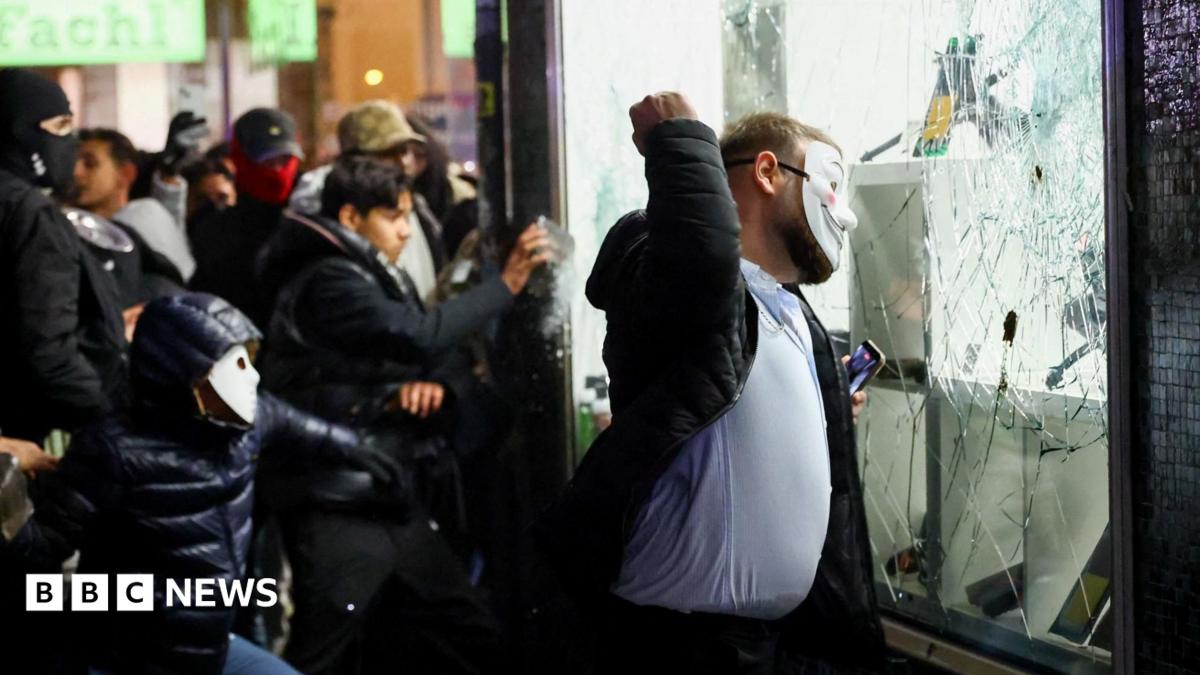
Similar instances took place in other German cities, following earlier largely peaceful demonstrations.
In Cologne, police said officers were attacked near the main train station, with bottles thrown and a bicycle launched.
Cologne’s police chief Johannes Hermanns said it was “deeply saddening that young people who wanted to peacefully demonstrate for their future were infiltrated today by extremists who had nothing but violence in mind”.
A smaller demonstration in the evening in Berlin – following larger protests in the day – resulted in 27 police officers being injured, and up to 56 people temporarily detained, Berlin police said.
In Hamburg, people dressed in black set off fireworks and set barricades on fire, with public broadcaster NDR reporting that 120 people were arrested.
The protests in Germany took place on the same day as other large-scale demonstrations in Europe.
In France, more than 320,000 people took part in a third consecutive weekend of largely peaceful protests in cities across the country, demanding action on the high cost of living and poor public services, especially in the education sector.
Thousands of police officers were deployed across France to deal with the demonstrations, and officers fired tear gas at demonstrators in some cities.
There were more than 500 arrests after clashes in Toulouse, Lyon and Marseille.
French Interior Minister Laurent Nuñez said a police officer had been injured by a molotov cocktail. Police in Paris said several hundred rioters had attacked security forces with projectiles.
Protests also took place in Italy, with some clashes between police and demonstrators in Rome and Turin.
In Portugal, police moved to clear a new tent camp assembled after thousands marched to protest against a rental bill that they argue could worsen a housing crisis in the country, where house prices have more than doubled over the past decade.
Mostly young protesters have recently taken to the streets in a swathe of European nations: France, Belgium, Ireland, Spain, Portugal, Italy, Greece, Serbia and Albania.
While the specific demands vary from country to country, the protesters have largely focused on cost-of-living issues, such as access to housing, the quality of education and cuts to public services.