NEAR turned six today, accompanied by an anniversary post outlining the protocol’s progress.
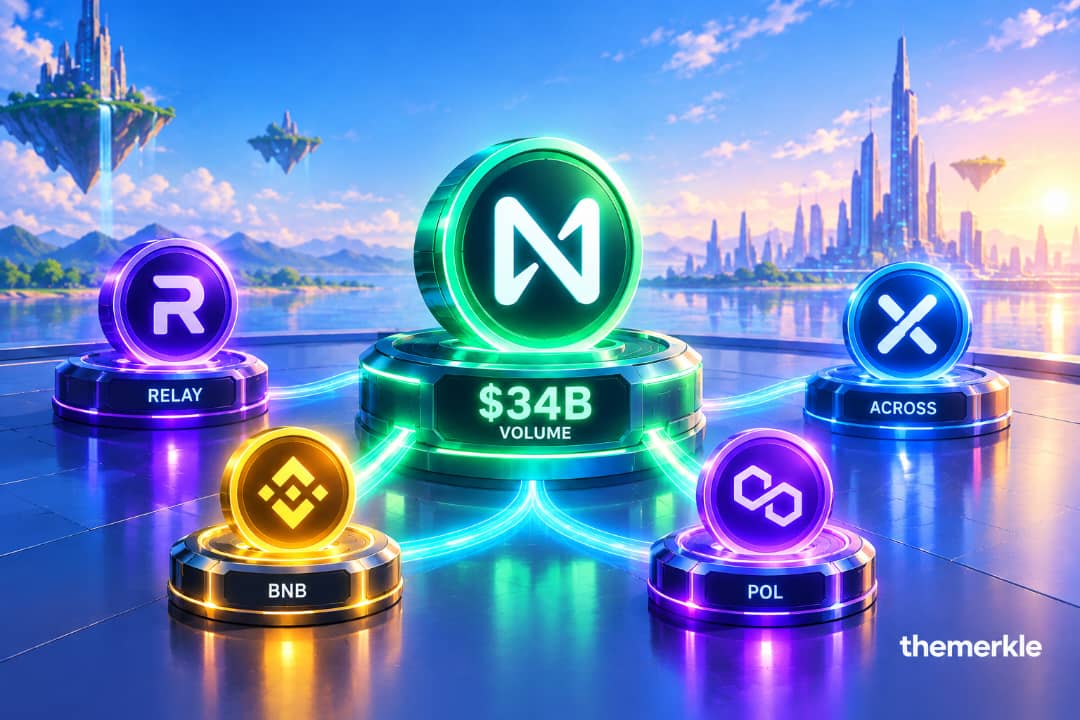
A standout metric in the release indicates that NEAR Intents has processed $34 billion in cumulative volume, up from $2 billion a year prior.
While “default” is a significant designation for infrastructure, comparing tracker data reveals where NEAR Intents actually sits relative to competing cross-chain systems.
What the Anniversary Post Claims
The official announcement states that NEAR Intents processed $34 billion in volume, a sharp increase from $2 billion during the same period last year, while expanding to 35 chains with dozens of application integrations. Additionally, the post highlights that Confidential Intents reached $3 billion in volume and $170 million in total value locked (TVL). Cross-referencing public metrics provides further context. On DefiLlama’s NEAR Intents page, cumulative volume stands near $33.6 billion, placing the $34 billion figure within a reasonable rounding range. However, independent confirmation remains limited for the $2 billion baseline, the 35-chain total, and the Confidential Intents figures on third-party trackers.
How NEAR Intents Looks Right Now
Data from DefiLlama shows $4.74 billion in volume over the past 30 days, $227 million in TVL (a 66% increase over the month), and gross fees of approximately $7.99 million during that stretch. NEAR captured protocol revenue of roughly $2.22 million, which DefiLlama notes is deployed toward open-market NEAR token buybacks. Q3 swap fees totaled $14.43 million. Dividing total fees by volume yields an average execution cost of approximately 17 basis points, meaning every dollar swapped generates about 0.17 cents in fees.
DefiLlama categorizes NEAR Intents under bridge protocols, ranking it 19th by TVL among 157 platforms. Given that TVL can be an imperfect benchmark for pass-through transaction layers, transaction volume provides a clearer measure of activity.

The Competition on Volume
A side-by-side comparison offers clearer perspective on market positioning. According to DefiLlama’s bridges page, 30-day volumes show Relay leading with approximately $7.7 billion, followed by Across at $6.8 billion. Over the same period, USDT0 handled $3.1 billion, IBC moved $2.1 billion, Circle Gateway registered $916 million, Stargate recorded $897 million, and Mayan processed $631 million. Total volume across all listed bridge infrastructure reached $24.9 billion.
Placing NEAR Intents’ $4.74 billion alongside these figures ranks the protocol third overall, trailing Relay and Across while outperforming the remaining competitors. Consequently, the platform occupies a strong market position roughly eighteen months into its expansion. Nevertheless, securing status as a “default” layer typically requires market leadership rather than trailing the top two rivals.

The Caveat That Matters
Interpreting these metrics requires caution because trackers do not apply identical methodologies across platforms. DefiLlama categorizes NEAR Intents under swap volume, whereas its bridge dashboard measures raw cross-chain transfers. As a result, a cross-chain swap logged on one tracker may not be represented identically on another. These rankings should therefore be evaluated as an indicator of relative scale rather than an absolute leaderboard.
Lifetime volume totals reveal a similar dynamic. DefiLlama records approximately $48 billion for Relay and $50 billion for Across since tracking began, compared to $33.6 billion for NEAR Intents. While NEAR is a younger protocol and continues to narrow the gap, it still trails in total historical volume.
Reach and Aggregators
Network reach serves as another benchmark for default cross-chain infrastructure. DefiLlama metrics indicate that Relay supports 41 chains while Across connects 25. NEAR’s reported coverage of 35 chains places it between those two benchmarks, though independent verification of the full list remains pending. In the aggregator category, leading platforms include Socket and LI.FI, each logging roughly $1.2 billion in 30-day volume within an aggregator market totaling $5 billion. NEAR Intents does not feature on that list, indicating that it operates primarily as a settlement layer rather than a front-end aggregation route.
Where NEAR Pulls Ahead: Value Capture
The most distinct element of the data lies in value capture and revenue routing. DefiLlama notes that NEAR Intents’ protocol revenue is dedicated to purchasing NEAR tokens on the open market, directly tying platform usage to token demand. In contrast, Across lists $0 in protocol revenue on the same dashboard, though this distinction may stem from how trackers classify relayer fees. For token holders, this economic model represents a noticeable point of differentiation that aligns with the tokenomics updates highlighted in NEAR’s anniversary release.
The Security Question
Establishing a default cross-chain layer depends heavily on protocol security, and NEAR Intents experienced an operational challenge in early October. DefiLlama documented a bridge exploit on October 1 involving approximately $3.8 million on BNB Chain. Team statements reported across industry updates indicated that the vulnerability was isolated to deposit and withdrawal infrastructure, services were temporarily paused and restored, and affected users were promised full reimbursement. While a single security incident does not define a protocol’s trajectory, any infrastructure aiming to carry broad cross-chain volume will be evaluated on its ability to maintain resilience at scale.

The Verdict
NEAR Intents has earned a prominent position within cross-chain infrastructure. Tracker data positions it third in volume, backed by steady growth and a mechanics model that converts execution fees into token demand. However, it is not the default cross-chain layer yet. Achieving that status requires bridging the volume gap with Relay and Across, verifying its chain expansion metrics, and demonstrating sustained security across high transaction volumes. Trackers over the coming months will provide a clearer picture than any single anniversary milestone.
Disclosure: This is not trading or investment advice. Always do your research before buying any cryptocurrency or investing in any services.
Follow us on Twitter @themerklehash to stay updated with the latest Crypto, NFT, AI, Cybersecurity, and Metaverse news!